
Abrasive Filament
Common Applications
Sanding and Deburring Applications
- Raw wood
- Reclaimed wood cleaning
- Stain and sealer scuffing
- Textiles
- Plastic parts scuffing
- Tube end
- Edges on metals, plastics and veneers
- Circuit board prep
- Surface adhesion prep
Finishing applications
- Graining of primary metals (aluminum, steel, copper, etc.)
- Surface prep for paint adhesion
- Metal strip rolling mills (cleaning)
- Cleaning of copper, brass and other primary metals
Highlights
- Grit Is infused throughout the bristle, not coated like sandpaper
- Individual bristles better follow contours and detailed profiles while preventing dust loading
- Can be used in wet or dry environments
- Nylon base gives brush good resistance to chemicals and to bending fatigue failure
- Typical abrasive nylon bristle is approximately 70% nylon and 30% abrasive by weight
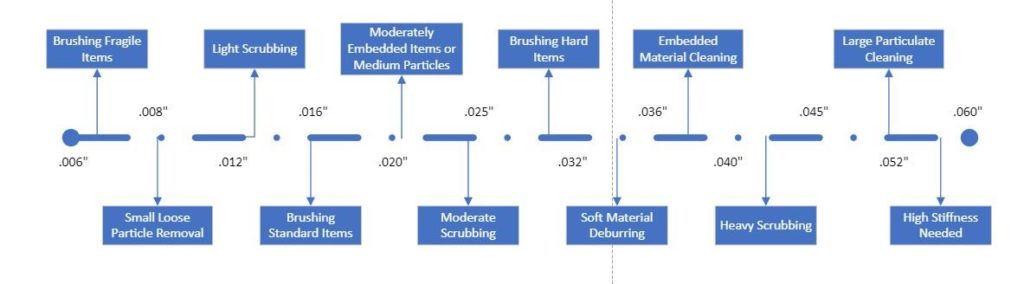
- Bristle diameter and stiffness increase as more aggressive grits are used
- Bristles more prone to fracture as grit size is increased due to the cross-sectional ratio change
- Not suitable for certain non-continuous profiles with extremely deep changes in profile
Abrasives are available in Silicon Carbide, Aluminum Oxide and Ceramic. Grits available include 500, 320, 240, 180, 120, 80, 60 and 46 grit. Abrasive nylon brushes can be wound using our Fineset™, and Double Band Channel (DBC) winding technologies.
Abrasive nylon brushes are most commonly wound with our Fineset™ technology due to the wide range of densities and variety of spiral patterns possible. DBC winding technology is most commonly used for applications needing maximum density and the most aggressive nylon grits.
Brush constructions are available in a variety of spirals, densities (in bristles per square inch), and bristle trim lengths.
Spec Sheet for a Quote
Engineered Abrasive Filaments for Surface Conditioning
Abrasive nylon filaments combine synthetic polymer strength with embedded abrasive particles to create a controlled, uniform cutting action. Unlike coated abrasives, the grit is distributed throughout the filament cross section, allowing the brush to maintain performance as it wears. This structure supports consistent finishing, deburring, and surface preparation across a wide range of materials and geometries.
Fineset and Double Band Channel Abrasive Constructions
Abrasive brushes can be produced using Fineset spirals, dense Fineset patterns, or Double Band Channel (DBC) constructions. Fineset designs support a wide range of densities and spiral configurations for controlled surface engagement on flat or irregular shaped parts. DBC constructions are selected when maximum filament concentration and aggressive cutting action are required. Both options can be configured in multiple trim lengths and bristle densities to match application demands.
Performance Characteristics of Abrasive Nylon
Abrasive nylon filaments typically contain approximately 70% nylon and 30% abrasive by weight. As grit size increases, filament stiffness and cutting aggressiveness increase as well. The nylon base provides resistance to chemicals, bending fatigue, and moisture absorption, allowing brushes to be used in wet or dry environments. Individual filaments conform to contours and profiles, reducing dust loading and improving consistency on irregular surfaces.
Construction Flexibility for Process Optimization
Brushes can be manufactured in multiple spirals, densities, and trim lengths to match machine requirements and desired surface finish. Fineset constructions are commonly used for general abrasive applications due to their versatility, while DBC constructions are selected for maximum density and aggressive cutting performance. Brushes can be tailored to continuous or intermittent contact conditions, though extremely deep, non continuous profiles may require alternative filament types.
FAQ
Which Abrasive Types Are Available for Nylon Filament Brushes?
Abrasive nylon is available with silicon carbide, aluminum oxide, and ceramic abrasive. Each material offers different cutting characteristics suited to specific substrates and finishing requirements.
How Does Embedded Grit Improve Brush Performance?
Because the abrasive is distributed throughout the filament, the cutting action remains consistent as the brush wears. This differs from coated abrasives, which lose effectiveness once the surface layer breaks down or becomes loaded with contaminate.
Which Applications Benefit Most from Abrasive Nylon Brushes?
Common uses include deburring, scuffing, edge preparation, wood finishing, metal graining, and cleaning of primary metals. They are also used for adhesion prep and circuit board surface conditioning.
Also see: Natural Fiber | Wire | Nylon and Synthetics