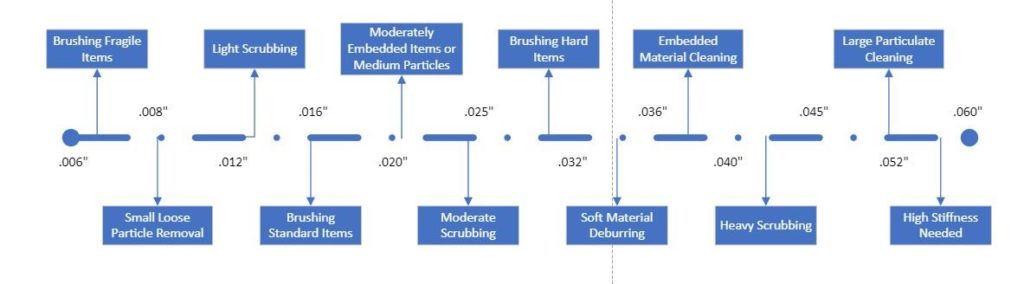
Synthetic filaments are most commonly seen in our Fineset™ brushes due to the wide variety of densities, spirals and trims available. When a more aggressive scrubbing action is needed, Tufted™ brushes are used. DBC brushes are used when extreme density is needed.
Constructions are available in a variety of spirals, densities (in bristles per square inch), and bristle trim lengths.
Fineset and Double Band Channel Brush Options
Fineset constructions are made using a patented process that bonds individual filaments to a core when uniformity density and bristle retention is required. This allows the filaments to flex as individual fibers. Fineset constructions use densely packed synthetic filaments arranged in controlled spirals or open patterns to support smooth application of liquids, coatings, adhesives, and other materials. Dense Double Band Channel (DBC) brushes provide increased filament concentration for applications that require heavy brushing and added durability. These constructions are available in multiple spirals, densities, and trim lengths to match process requirements.
Tufted Brush Configurations for Aggressive Contact
Tufted brushes are also made using a patented process that bond clumps of bristles to a core when higher contact pressure or more aggressive scrubbing action is required. This allows the filaments to flex as groups of fibers. Dense staggered tuft patterns and two-way spiral arrangements support cleaning, conveyor maintenance, and surface preparation across substrates such as glass, paper, wood, metal, textiles, rubber, and plastics. Tufted designs allow for controlled stiffness and filament engagement, making them suitable for both wet and dry environments.
Material Characteristics and Performance Advantages
Nylon filaments offer excellent chemical resistance, fatigue resistance, and dimensional stability. They maintain consistent absorption rates and minimal softening when used with water based or solvent based materials. Standard nylon can be used up to 250°F (120°C), with higher temperature formulations available for demanding environments up to 350 F (180C). FDA compliant grades and multiple color options support food processing, pharmaceutical, and inspection driven applications.
Common Application Areas
Fineset brushes are used for light cleaning, material transfer, leveling, smoothing, and coating applications in industries such as industrial baking, printing, pharmaceuticals, textile, glass and web converting. Tufted brushes support cleaning, scrubbing, and conveyor maintenance. DBC constructions are selected when maximum filament density is required for uniform application or heavy surface contact.
FAQ
Which Brush Construction Is Best for Material Transfer Applications?
Fineset brushes are typically used for applying coatings, adhesives, glues, and other liquids due to their controlled density and uniform filament engagement. DBC constructions are selected when higher filament concentration is required.
Can Nylon Brushes Be Used in High Temperature Environments?
Standard nylon supports temperatures up to 250°F (120°C). High heat formulations are available for applications requiring elevated thermal resistance up to 350F (180C).
Which Applications Require Tufted Brush Designs?
Tufted brushes are used for cleaning, scrubbing, and surface preparation on materials such as glass, metal, wood, textiles, and plastics. Their construction supports higher contact pressure and more aggressive action.
Also see:
Abrasive Nylon | Wire | Natural Fibers