
Wire Filament
Common Applications
Cleaning
- High-temp environments
- Bakery belts and forming belts
Distressing
- Wood structuring
- Composite and metal graining
Deburring
- Tube end deburring
- Edge deburring
- Gear deburring
Metal Finishing
- Roll Mills for primary metals (copper, aluminum, steel, stainless steel)
- Metal surface prep (rust removal, slag removal deep scuffing)
Material Highlights
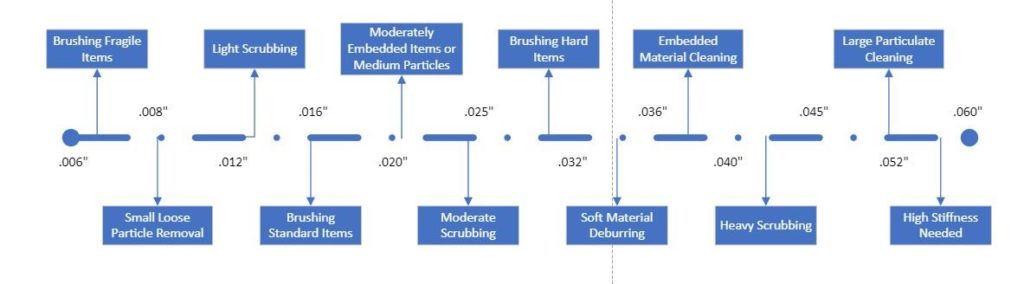
- Available in a wide variety of filament diameters and materials
- Single strand diameters range from .004″ (.1mm) to .025″ (.65mm)
- Braided wire strands average .075″ (1.9mm)
- Available in carbon steel, stainless steel, brass and brass-coated carbon steel
- Stable brushing performance over the useful life of the brush
- Individual wires prevent the brush from loading up with debris
- Individual wires follow detailed profiles and allow for a finer brushing action
- Various wire types allow for use in dry or wet environments with different chemicals
- DBC brushes are denser with much stronger bristle retention than single band brushes
Wire brushes can be wound using our Double Band Channel (DBC) winding technologies. Wire filaments are the stiffest and hardest of the filament types offered.
Constructions are available in a variety of spirals, densities (in bristles per square inch), and bristle trim lengths.
Engineered Wire Filaments for Heavy Duty Brushing
Wire filament brushes provide the highest stiffness and cutting capability among industrial brush types. Their construction supports aggressive cleaning, deburring, and surface conditioning across metals, composites, wood and high temperature environments. Individual wire strands maintain consistent contact with the work surface, preventing debris loading and enabling controlled brushing action on detailed profiles.
Performance Characteristics of Wire Filament Brushes
Wire brushes maintain stable brushing performance throughout their service life due to the inherent rigidity of the filaments. Individual wires prevent clogging. DBC (Double Band Channel) constructions provide enhanced bristle retention and higher density compared to single band strip designs, making them suitable for demanding industrial processes.
Construction Flexibility for Process Optimization
Brushes can be produced in multiple spirals, densities (bristles per square inch), and trim lengths to match machine requirements and desired aggressiveness. Wire filaments are the stiffest and most durable option in the filament continuum, making them suitable for heavy duty industrial environments where synthetic filaments may not provide sufficient cutting action.
FAQ
Which Wire Materials Are Available for Industrial Brushes?
Wire brushes can be manufactured using carbon steel, stainless steel, brass, and brass coated carbon steel. Material selection depends on corrosion resistance, conductivity, and required brushing aggressiveness.
What Is the Difference Between Single Strand and Braided Wire?
Single strand wire provides flexibility and finer brushing action, while braided wire offers higher stiffness and more aggressive cutting. Braided strands are typically used for heavy duty deburring and surface removal.
When Should Dense Wound Brushes Be Used?
Dense wound brushes are selected when maximum filament engagement and aggressive brushing action are required. They are commonly used for deburring, rust removal, wood structuring and slag removal in roll mills.
Can Wire Brushes Be Used in High Temperature Environments?
Yes. Wire filaments, especially stainless steel and carbon steel, perform well in elevated temperatures and are suitable for cleaning oven chains, bakery belts, forming belts, and industrial heating processes.
Also see: Abrasive Nylon | Wire | Natural Fibers